Home
Mission Statement
Editorial Policy
Submission Information
Volume One
Casual Papers
Fort Guijarros
Volume Two
To view pdf files you will
need Adobe Reader.

Introduction
Seth Mallios and Dominique Rissolo
Every place has a history and significant tales to tell, and archaeologists
constantly work to uncover these stories. Their traditional tools are
shovels, trowels, and dental-picks; but excavation is also a metaphor
for the task by which archaeological scholars are compelled. Their work
is to investigate the past, and they do so in myriad ways, always with
their minds but not necessarily with their trowels and shovels in hand.
This journal, the San Diego State University Occasional Archaeological
Papers (the SOAP), seeks to be a conduit for those in San Diego who “excavate.”
It is dedicated to the dissemination of insight from archaeological investigations
with a tie to San Diego County. Overall, the SOAP seeks analytical and
interpretive expertise from informed points of view that contribute to
a better understanding of San Diego County, its archaeological record,
and its archaeological community.
The SOAP has its own historical context, growing out of the San Diego
State University Cultural Resource Management Casual Papers. These were
a two-volume series published in-house and edited by Chris White from
September 1982 through July 1986. Seventeen years later, in 2003, Anthropology
Department Chair and Professor Larry Leach expressed a desire to see the
publication resuscitated. Thus, today’s SOAP is built on the legacy
of the Casual Papers, embracing a common goal of providing information
related to San Diego County archaeology in a timely fashion. In addition,
it has expanded the parameters of the original Casual Papers. The SOAP
is free, electronically accessible, and maintains an editorial advisory
board with a double-blind juried review process. A benefit of the electronic
format is that this journal can offer its readers immediate digital access
to the collected works of the aforementioned two-volume Casual Papers
series. In addition, the SOAP is pleased to showcase journals that the
Fort Guijarros Museum Foundation published between 1987 and 1995. These
publications detail the work accomplished by the Fort Guijarros project
during its extensive historical and archaeological investigations of Ballast
Point, Point Loma, in San Diego. It is our expectation that easy public
access to these writings will serve the San Diego Archaeological community
in an affordable, timely, and informative way.
The SOAP will fluctuate in temporal and topical focus, depending on the
nature of the submissions and the dynamics of the review process. Still,
readers can be assured that it will always address San Diego County archaeology
and the interests of its practitioners.
This inaugural volume of the SOAP has three parts. The first section of
Volume I focuses on San Diego State University. It begins on campus with
the recent rediscovery of two fragmented Works Progress Administration
murals from the 1930s. Thought to have been destroyed by construction
decades ago, these images were unknowingly sealed behind ceiling tiles
in the basement of Hardy Tower. Routine maintenance briefly exposed the
historic murals in the late summer of 2004 and enabled them to be digitally
recorded. Seth Mallios and Nicole Purvis’s discussion of these forgotten
WPA murals leads to an overview of the historic district at the heart
of the current SDSU campus. Sue Wade, Alexander Bevil, and Lynne Christenson
successfully nominated this historic district for inclusion on the National
Register of Historic Places in 1997. They now offer an article-length
summary of their findings that highlights the origins and development
of San Diego State University. Cynthia Eischen also looks at an aspect
of the university’s local history, examining its many archaeologists
from the late 19th century through 1975. Then, acclaimed archaeological
alumnus M. Steven Shackley concludes part one of this volume with a retrospective
on his memories of SDSU’s Anthropology department. Shackley, currently
Professor of Anthropology and Director of the XRF Laboratory at the University
of California, Berkeley and North American Editor of Archaeometry, received
his B.A. and M.A. from San Diego State in 1979 and 1981 before heading
to Arizona State University for doctoral work. He is a leading figure
in the archaeological sciences and credits much of his analytical rigor
to lessons learned during his SDSU tenure.
Part two emphasizes current archaeological research in San Diego County.
Don Laylander’s investigation of potential ramifications from Lake
Cahuilla’s environmental transformations links archaeological evidence
with various forms of social change. He discusses a number of possible
repercussions—technological diffusion, differential language distribution,
and alterations in subsistence strategies, growth rates, and community
organization—that correspond with distinct changes associated with
the rise and fall of the lake over time.
The third and final section of this volume consists of recent insights
from the Fort Guijarros Museum Foundation. Each article draws on the 1981-1995
excavations at Ballast Point. Milford Wayne Donaldson, the current California
State Historic Preservation Officer, begins this section of the journal
with a discussion of the actual position and orientation of the fort walls.
Ronald V. May then provides an overview of the 15-year excavation span
and includes detailed stratigraphic information to compliment the established
historical chronology. Finally, C. Fred Buchanan’s detailed analysis
of the site’s core structure enables a series of archaeological
deductions to be made regarding the planning, construction, and destruction
of the fort. As part of its dedication to local archaeology, the SOAP
includes all of the past Fort Guijarros articles and volumes in its digital
archive. Volumes 1-3 of the Fort Guijarros Quarterly can be accessed through
the main SOAP webpage http://soap.sdsu.edu.
The collection of articles presented in this inaugural volume reflects
only a small fraction of the current diversity in San Diego County archaeology.
The remarkable depth and breadth of archaeological work in the region
can ensure that the SOAP consists of quality submissions for decades to
come. Local archaeologists are dedicated to understanding and appreciating
diverse peoples and materials of the past, although their motivations
vary. Whether prompted by a specific set of research questions, a concern
for historic preservation, a desire to teach the next generation proper
field skills, or some other catalyst, San Diego archaeologists are actively
pursuing insight into the region’s history and prehistory. The San
Diego State University Occasional Archaeological Papers (SOAP) are at
their service, ready to present their findings in a timely and rigorous
manner (Figure 1.1).
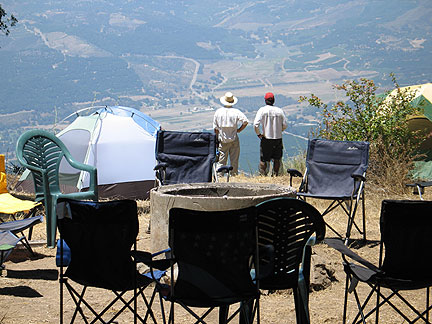
Figure 1.1 Atop Palomar Mountain in the summer of 2005,
Assistant Editor Dominique Rissolo and
Editor Seth Mallios ponder San Diego archaeology after a day of excavation
at the Nate Harrison Site. Courtesy of Donna Byczkiewicz.